my weekend: Seido Aichi Benefit tournament and 20th anniversary celebration
On the bus for the trip to Ise Shrine with the Seido crew. Time for a quick update...
First, unrelated to the trip -- very good news about our friend Ian Hesford. He's been waking up and talking a little, even making jokes. Not to minimize the long road ahead, but this is amazing news.
Anyway. I'm in Japan! Took some complications to get here. JAL canceled my flight from Boston to Tokyo last Wednesday due to a maintenance issue. (On a new plane, no less.) Apparently they didn't the have the necessary part and had to have one brought from LA. They rescheduled for Thursday and put us up at an airport hotel for the night.
This blew a hole in my plan to hop from Narita (the Tokyo airport) to Kansai (the Osaka one), rest in Osaka for the night, and take the train to Nagoya the next day. I did get then to fly me from Tokyo to Nagoya so I got to Nagoya late Friday night -- after another delay at Narita.
Stumbling bleary-eyed from the airport to the train station, I heard someone call "Sensei Tom?" It was Sensei Hiroaki Kondo from the Seido Aichi branch, who was coordinating with foreign visitors and was coincidently there to meet another arriving karateka. So nice to see a friendly face! He got me pointed in the right direction. I got to my hotel and just about collapsed, too tired to get much sleep.
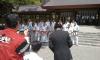
Saturday morning, tired but happy to be here, I went to the workout at Atsuta Jinga, one of the most pre-eminent Shinto shrines. Atsuta Jinga is said to hold Kusanagi no Tsurugi, the sword that is said to be a gift from Amaterasu Ōmikami and one of the Three Sacred Treasures of Japan. I'd guess about 100 students, children and adults, attended.
We started with a brief Shinto ritual -- these are not really "religious" in the Western sense, as Shinto really doesn't have domga, but a mythology and a set of attitudes that it tries to cultivate. For this we were let into one of the outer sanctums of the shrine, past a fence where ordinary visitors have to stop. It's not like we got in to see the sacred sword itself or anything, but I think that we were brought in and permitted to have a brief workout on the grounds shows the respect that Kaicho Nakamura and Seido Karate enjoy in Japan.
Then we lined up for the workout. I think we ended up in aot of tourist photos that day! Kiai echoed over the shrine grounds as we did basic techniques, Kaicho exhorting us to give it our all. Then each rank group got to do a kata.
Yondan and more senior students did Sai Kata Ganki Dai. (The folks at Customs got a kick out of my sai, by the way.) And in my gut I like to think that the fact that I did a sai kata on the grounds of the shrine that is the repository of such a sacred sword, somehow charges them up with mana.
Most inspiring, though, was a young yellow belt student in wheelchair. I believe he had cerebral palsy or a similar condition. He was taken out of his chair and sort of knelt or sat on the ground (the gravelly ground), throwing his legs and body forward with each step of the kata. An amazing display of the "non-quitting spirit"; it made me proud to be a Seido student.
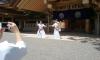
After the workout, those who wished (and paid a small fee) were invited to a special ritual, a blessing of sorts for Kaicho and Seido. It included a stunning dance by two priestesses, very precise and forceful; and ended with a sip of sake -- a practice of which I heartily approve!
After a nap, Saturday night I headed over for the anniversary banquet. I gave a small present (a Maryland flag signed by many students with congratulations) to Jun Shihan Toshihide Sawahira, Seido Aichi branch chief. I also had a gift for Sensei Kondo, in appreciation for all of his help. (He has been absolutely amazing in coordinating things. As we ride back from Ise I see that he has fallen asleep in his seat, a well-deserved rest.) Of course the speeches at the banquet were in Japanese. and even with a translator summarizing, I'm sure I missed much. But the affection and admiration that the students have for both Jun Shihan Sawahira and for Kaicho Nakamura needed no translation. I also got to meet several students from New Zealand and from Honbu and Johshin Honzan. So many new people to meet I fear I'll never remember everyone's names!

Sunday, the tournament. Yondan students were not eligible to compete, so I was a judge. (And as I was still pretty exhausted maybe it was best that I didn't compete.) I ended up as chief judge for junior brown and yellow belt kata divisions, and with a bit of help on translation I think things went smoothly. (It occurs to me that sometimes you have to give someone some help before they're able to help you or others, a thought worth further exploration.) I also helped judge shodan men's kata (saw a lot of Seienchin!) and was a kumite corner judge for junior green belt boys, lightweight (I think, the weight classes are a little different) black belt men, and junior black belt girls. Everyone showed strong spirit and good sportsmanship. Especially moving was a mildly handicapped shodan who competed in kata. I believe that the young yellow belt I'd seen at Atsuta Shrine also competed. They were wonderful reminders that the purpose of these tournaments is to help push each of us to be our best.
Right after the tournament I had to go back to the hotel, get online, and deal with an emergency at the day job. Sadly this made me late for the "uchiage" (after tournament) party. But I got there (and, this being Japan, was mildly scolded for being late), and enjoyed several drinks and conversation with fellow karate students, as well as a rousing sing-along of "YMCA" led by Jun Shihan Sawahira.

Today, a bus trip to Ise Jinga, another one of the most pre-eminent Shinto shrines. Again there was a special ritual dance ("kagura") dedicated to Kaicho and Seido karate. Just amazing. Watching it I could feel the stress of the past few weeks leaving me; such a feeling of gratitude to see something like this. I had planned to visit Ise on a previous trip to Japan, but ended up missing a train -- if I'd gone then, though. it would have been nothing like what I got to experience today.
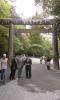
After lunch, a sudden heavy rain soaked us as we returned to the bus, the sort of soaking that makes everyone laugh. (Glad I bought an umbrella before things got bad, so I'm only soaked from the knees down!) A wonderful end to the trip. Bus back to Nagoya now, where I'll probably rest up and do laundry tonight. Off to Toyko tomorrow.